
Dylan House
Construction contract types—and why we usually go lump-sum fixed price

Last time we talked about how to find a good contractor and why a clear written agreement matters. This post is the next piece: what kind of contract you’re signing.
Same goal as before—not to sell you on House Custom Carpentry, LLC, but to help Eastern NC homeowners understand the paperwork before they write a check. If you hire us, great. If you hire someone else solid, still use a contract that fits the job.
Why a written contract protects both sides
A remodel contract is not a trap. It’s a shared map.
It tells everyone what’s included, what’s not, how money moves, how changes get approved, and what happens when something goes sideways. You get protection against surprise bills and unfinished work. The contractor gets protection against unpaid labor and endless “while you’re here” extras that were never priced.
No handshake. No “we’ll figure it out.” Guidance and protection for both parties—on paper.
The main types (in plain English)
1. Lump-sum / fixed price (our go-to)
What it is: You and the contractor agree on a total price for a defined scope of work. That price is the price—unless you both sign a change order that adds or removes work.
What it excels at:
- Kitchens, baths, additions, and other jobs where the scope can be designed and measured up front
- Homeowners who want to sleep at night knowing the number
- Builders who are willing to do the hard estimating work before the first hammer swing
Tradeoffs:
- Takes more time and effort from the builder up front to price carefully
- Requires a solid scope (and usually solid design) so the number means something
- Unknowns that appear later get handled through change orders—not by quietly padding your bill every week
Why this is my default at HCC:
I’ve found customers are happier when they know the cost up front. They worry less. They don’t feel like the meter is running every time someone opens a wall. Costs only change when you choose a change—and we write that change down.
Yes, fixed price is harder on the builder. Estimating a remodel right takes hours. That’s our job. I’d rather sweat the pricing on the front end than keep the homeowner guessing on the back end.
We pair this with a clear scope, milestone payments, and change orders—covered in the earlier post.
2. Cost-plus
What it is: You pay the actual costs of the job (labor, materials, subs, etc.) plus an agreed fee or percentage for the contractor’s overhead and profit. The books stay open: the builder shows receipts and costs as the work goes.
What it excels at:
- Jobs where the true scope can’t be known until work is underway (severe unknowns, exploratory demolition, “open it up and see”)
- Situations that need maximum flexibility more than a locked number
Tradeoffs:
- More record-keeping for the builder—and more transparency required
- More risk and uncertainty on the homeowner: the final number isn’t fixed when you start
- Trust has to be high, because you’re funding actual costs as they land
When I’ll use it:
Occasionally—and only when it’s genuinely impossible to know the scope ahead of time. Cost-plus is a tool for uncertainty, not a shortcut around planning. If we can design it and price it, I’d rather give you a lump sum.
3. Guaranteed maximum price (GMP)
What it is: Often built like cost-plus, but with a ceiling. You pay actual costs plus fee, up to a maximum. Above that cap, the contractor typically eats the overrun (unless a change order adds scope).
What it excels at:
- Larger or complex work where you want cost transparency and a hard stop
- Owners who won’t accept an open-ended bill but still want flexibility during construction
Tradeoffs:
- Needs enough design and estimating to set a meaningful maximum
- Savings under the cap are sometimes shared or returned to the owner—spell that out in writing
- Not as simple as a single fixed price; paperwork is heavier
Think of GMP as a hybrid: openness of cost-plus, with a lid for the homeowner.
4. Not-to-exceed (NTE)
What it is: A cap language you’ll often see on time-and-materials (or sometimes cost-plus) work: labor and materials are billed as incurred, but total billings won’t go past an agreed not-to-exceed amount without a written change.
What it excels at:
- Repair or exploratory work that can’t be fully priced on day one
- Giving the homeowner a “won’t go past this without talking” fence
Tradeoffs:
- Still not the same peace of mind as a true lump sum for a fully designed remodel
- The NTE only works if the scope of what’s inside the cap is clear
NTE and GMP both create a ceiling. GMP is usually the fuller “cost-plus with a max” package; NTE is often the cap bolted onto T&M.
5. Time and materials (T&M)
What it is: You pay agreed labor rates for time spent, plus materials (often with a markup). No fixed total unless you add an NTE.
What it excels at:
- Small repairs, service calls, and “we don’t know what’s behind that wall yet” work
- Speed when stopping to write a full fixed bid would cost more than the job
Tradeoffs:
- Homeowner carries more cost risk if the job grows
- Needs honest time tracking and clear rates in writing
For tiny, uncertain work, T&M (sometimes with NTE) can be the honest tool. For a planned master bath or addition, I’d rather lock a lump sum.
Quick comparison
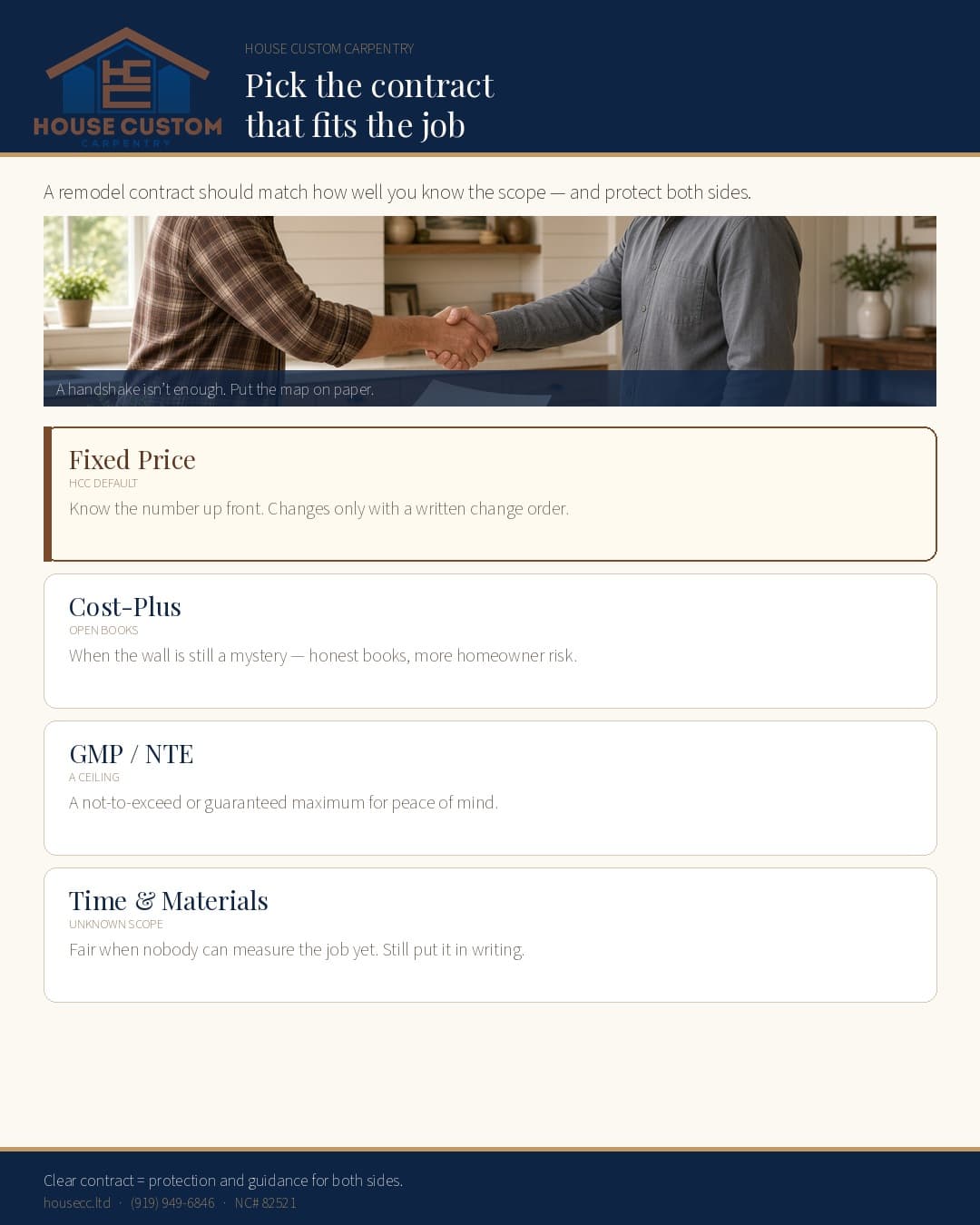
Details
| Type | Price certainty | Flexibility | Who carries overrun risk | Excels at |
|---|---|---|---|---|
| Lump-sum / fixed price | High | Lower (via change orders) | Contractor (within defined scope) | Designed kitchens, baths, additions |
| Cost-plus | Low | High | Homeowner | Unknown / exploratory scope |
| Guaranteed maximum price (GMP) | High (ceiling) | Medium–high | Contractor above the cap | Complex work wanting transparency + a lid |
| Not-to-exceed (NTE) | Ceiling only | Medium | Contractor above NTE (if scope is clear) | Repairs / T&M with a fence |
| Time and materials (T&M) | Low (unless NTE added) | Highest | Homeowner | Small repairs, service, unknowns |
How to choose
Ask one question first: Do we know enough to price this fairly?
- Yes — drawings, measurements, finishes path, clear scope → lump-sum fixed price is usually the kindest path for the homeowner. That’s our default.
- No — walls have to open before anyone knows the truth → cost-plus, T&M, or T&M with NTE may be more honest than a fake fixed number.
- Mostly yes, but you want a hard ceiling with open books → talk GMP.
Whatever you pick, put it in a real contract with scope, payment schedule, change-order rules, insurance proof, and standards—same foundation as the earlier guide.
Our house rule at HCC
Lump-sum fixed price whenever the job can be defined.
Cost-plus only when the scope truly can’t be known up front.
Always a written agreement. Always change orders for changes. Always a payment schedule that doesn’t ask the contractor to bankroll the job—or ask you to hand over everything on day one.
That combination—clear price, clear scope, fair draws—is how we keep projects calmer for the people living in the house.
Earlier: How to find a good contractor
Reputation, who shows up on site, design/build, scope, payments, and insurance—the foundation this contract guide builds on.
Read the contractor guide →If you want help sorting this out
House Custom Carpentry, LLC is a licensed NC design/build remodeler (NC# 82521) serving Goldsboro, Pikeville, and Eastern NC. Call (919) 949-6846 or visit housecc.ltd. Bring your plans or your “we’re not sure yet”—we’ll tell you which contract type fits before anyone swings a hammer.
— Dylan House
NC General Contractor #82521